Crossword Master - Word Puzzle
- 4.8
- Rating
- 10.00M
- Installs
- Free
- Price
 Analysis by App-foxy
I spent time with Crossword Master - Word Puzzle as a compact daily word game, and my first impression was that it understands why people return to crosswords: the appeal is not only solving clues, but also noticing gradual improvement. It is a free game from Easybrain, aimed at anyone who wants short vocabulary sessions rather than a large adventure, story campaign, or competitive multiplayer experience. The presentation is straightforward, so the focus stays on reading clues, testing possible answers, and filling the grid.
That simplicity is its strongest quality. I could open it when I had only a few quiet minutes, make progress without preparing anything, and stop before the session became a commitment. At the same time, the game is not equally satisfying for every kind of puzzle fan. Players who want very elaborate themes, deep customization, or a clearly explained long-term progression system may find the experience restrained. For people who enjoy a regular crossword rhythm and want a gentle form of mental exercise, however, it is an easy game to understand.
How Crossword Master turns a small puzzle into a daily habit
I find Crossword Master works best as a small, shared-device activity when everyone treats the grid as a puzzle to take turns thinking about, rather than a race to finish. In this section, I look at how its quiet daily rhythm can fit into ordinary routines and why the most useful household habit is agreeing when a session is simply paused.
You May Also Like

 AccuWeather: Weather Radar
AccuWeather Review: A Quick, Clear Forecast for Everyday Decisions
For everyday plans, the best forecast is the one you can understand quickly. AccuWeather makes rain timing, radar, and local conditions easy to act on, with a few trade-offs.

 Hill Climb Racing
Why Hill Climb Racing Still Turns Crashes Into One More Run
A tiny car, a bumpy hill and one more upgrade: Hill Climb Racing keeps resurfacing because its simple chaos makes every near-miss feel personal.

 AliExpress - Shopping App
AliExpress Makes Global Shopping Feel Personal, but Shoppers Bear the Risk
AliExpress turns a global marketplace into a pocket-sized discovery engine. Its reach is useful, its shopping loop compelling, and its trade-offs easy to miss.

 Lords Mobile: Kingdom Wars
Lords Mobile Is a Kingdom-Building Routine, Not a Quick Match
A case-by-case verdict on the building, battles, device demands, and social commitments that make Lords Mobile rewarding for some players and exhausting for others.

 PDF Scanner app - TapScanner
TapScanner Makes Paperwork Easier to Capture, Check, and Share
TapScanner makes scanning with a phone feel less like a rescue operation and more like a dependable step in getting work done. Its capture tools are useful, though not flawless.

 Block Blast!
 Shows How Much a Puzzle Game Can Leave Out
A quiet grid game shows why puzzle players increasingly value instant clarity, repeatable skill and low-pressure play—and where the genre still needs to catch up.
More From Our News Desk
View All News


The opening goals are clear, even when the game stays quiet about them
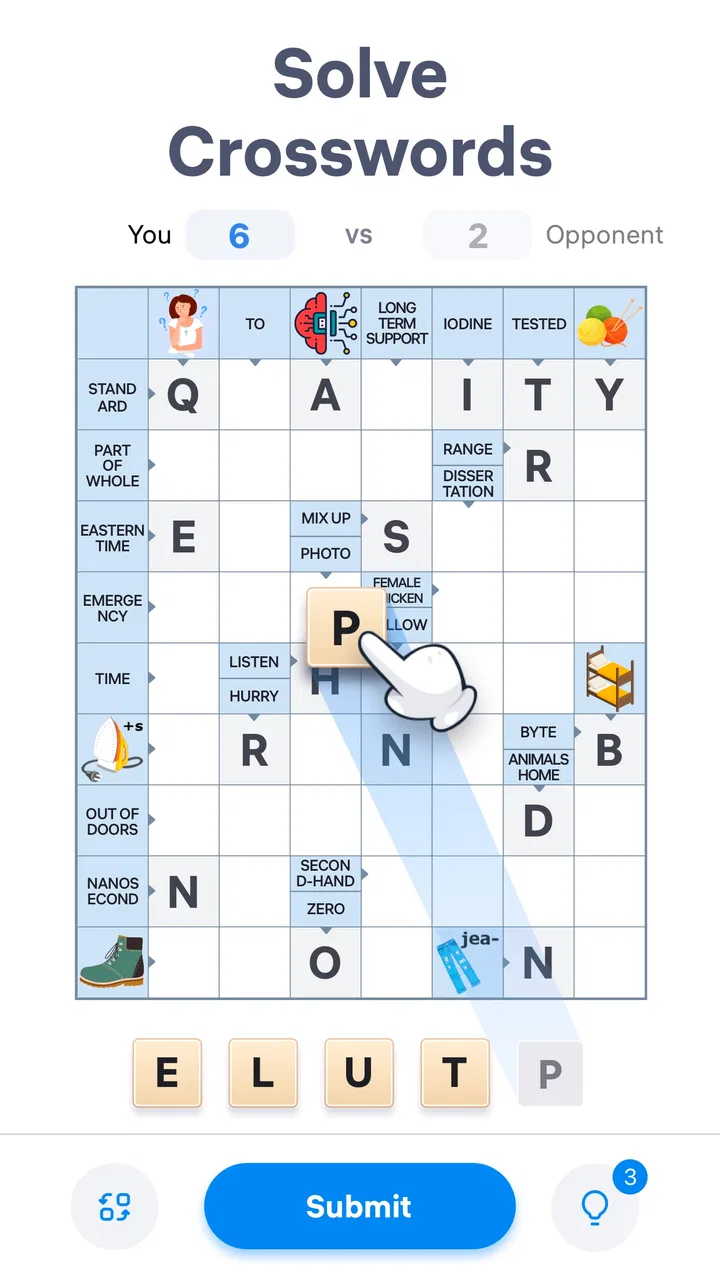
The early goal is simple: solve the crossword in front of me by using the clues and crossing letters to narrow down uncertain answers. That clarity matters. I never had to learn a complicated control scheme or work through a tutorial-heavy introduction before reaching the actual wordplay. The grid itself gives me an immediate task, while every completed entry creates a small sense of progress.
I particularly like how crossword solving creates several goals at once. The obvious objective is to finish the current puzzle, but there are smaller decisions inside it. I can begin with clues that feel familiar, use their letters to unlock harder entries, and return to a stubborn section once the surrounding words have reduced the possibilities. This makes the game feel more thoughtful than a simple vocabulary quiz, because the order in which I work can change how quickly the puzzle opens up.
That structure also makes the game approachable for casual players. Someone who has not solved crosswords recently can start with the clues they recognize instead of feeling forced to understand the whole grid immediately. I found that useful when playing while tired: answering a few accessible clues restored momentum, whereas staring at the most obscure clue first only made the session feel slower.
The early experience is best understood as a sequence of small wins rather than a dramatic tutorial. A filled word confirms that a guess was useful; a crossing letter gives a clue more shape; a completed area makes the remaining work less intimidating. The most effective early goal is not speed, but building enough reliable letters to make the next decision easier. That is a good lesson for new players, and it remains useful later.
Progress feels visible through solved space, not through spectacle
Crossword Master does not need a loud reward loop to show that I am moving forward. The clearest progress signal is the puzzle itself. Empty squares become letters, uncertain clues become answerable, and the overall shape of the challenge changes as I work. This is a modest kind of progression, but it suits the genre better than unrelated collectibles or decorative achievements would.
I also noticed that the game encourages a useful distinction between local and global progress. Solving one short word may not complete an entire section, yet its letters can influence several nearby clues. That means a move can be valuable even when it does not look impressive on its own. For me, this created a satisfying rhythm: make a reasonable answer, inspect the new crossings, then reassess clues that previously seemed impossible.
This design favors players who enjoy thinking in stages. I was rarely rewarded for forcing a guess immediately. Instead, the grid taught me to leave a clue temporarily, gather information elsewhere, and come back with better evidence. That makes the act of solving feel more deliberate than simply tapping through familiar vocabulary.
The progress signals are also easy to read during a short session. If I have only a little time, I can still finish a few entries and feel that the visit accomplished something. A longer session offers the possibility of completing the full puzzle, but the game does not depend entirely on reaching that endpoint for the activity to feel worthwhile.
One practical tip helped me avoid unnecessary frustration: I treated a partially filled grid as a working notebook rather than a test I had to pass in one uninterrupted attempt. When a clue resisted me, I moved to a different area and let the crossing letters do the hard work. This approach is especially effective for players who tend to interpret one difficult clue as evidence that they are failing.
The difficulty curve rewards patience more than memorized vocabulary
For me, the challenge comes less from obscure words alone and more from how clues interact. A familiar answer can still be difficult when only part of it fits, while a less familiar word may become obvious once enough crossing letters appear. That creates a difficulty curve based on deduction as much as recall. I appreciated that balance because it gives weaker vocabulary players a way to reason through a puzzle instead of simply hoping to know every answer.
The experience can still become demanding when several clues remain unresolved at once. That is where the pacing depends on whether I am willing to pause and change tactics. I found it more productive to scan the whole grid for a clue with a likely answer than to repeatedly attack the same blank entry. Each successful word then acts as a small hint for the surrounding area.
This is also where the game differs from a basic word-search title. In a word search, the main challenge is visual detection inside a fixed group of letters. Here, I have to interpret language, consider the length of an answer, and check whether it agrees with other entries. Compared with a spelling quiz, it gives more room for deduction. Compared with a traditional newspaper crossword, it offers a more convenient digital format for quick sessions, although players who prefer a strong editorial voice or highly distinctive themes may want a more specialized crossword app.
I would not describe the difficulty as universally relaxing. A player looking for a completely effortless brain break may occasionally meet a clue that slows the whole grid. That friction is part of the appeal for experienced solvers, but it can feel abrupt for someone expecting only easy vocabulary practice. The best way to approach it is to accept that a puzzle may alternate between quick answers and deliberate pauses.
Another useful habit is to separate confidence from certainty. I entered an answer when the clue and the word length made it plausible, but I kept checking it against the crossing letters rather than becoming attached to it. In a crossword, one early mistake can make several later clues appear impossible. Reviewing questionable entries before blaming the puzzle saved me time and made the challenge feel fairer.
Unlocks and pacing work best when the puzzle itself stays central
The game’s progression is most convincing when it keeps attention on solving rather than surrounding the activity with too many distractions. Each puzzle offers a contained objective, and the act of filling it provides its own unlock-like feeling: more of the grid becomes available to reason about, and the final unknowns become reachable. I prefer that kind of pacing to a system that interrupts every few minutes with unrelated tasks.
There is a trade-off here. Because the core loop is intentionally focused, players who need visible milestones, elaborate maps, or a strong sense of a campaign may find the journey less expressive. The satisfaction is internal to the puzzle. I know I am improving when I recognize clue patterns faster, recover from mistakes more calmly, or finish a difficult section with fewer random guesses. Those are meaningful signals, but they are quieter than the progression systems found in many other mobile games.
That quiet pacing suits a daily routine. I could treat a puzzle as a morning warm-up, a break between tasks, or a way to wind down without committing to a long play session. In an everyday scenario, I might open it during a coffee break, solve the clues that immediately stand out, leave two or three difficult entries unfinished, and return later with fresh attention. The game supports that stop-and-start mindset better than a game that punishes every pause or expects a continuous run.
It is also a reasonable choice for families because its content rating is Everyone. That does not mean every clue will be equally easy for every age group, but it does make the game broadly approachable as a word-focused activity. Adults who want a more demanding specialist crossword environment may eventually outgrow its accessible presentation, while younger or occasional players may appreciate the lower barrier to entry.
Where retention helps and where it can start to feel like pressure
A daily puzzle format naturally encourages return visits. The promise of a fresh word challenge gives the game a simple reason to remain installed, and the short-session structure makes returning feel manageable. I did not need to reserve a large block of time to benefit from it. That is a strong retention pattern because it grows from the activity itself rather than requiring a complicated social system.
Still, daily design can create pressure if I begin treating completion as an obligation. The healthiest way to use Crossword Master is as an optional routine, not a streak I must protect at all costs. Missing a session does not erase the value of solving when I actually have the energy to think. Players who dislike reminders, recurring challenges, or the feeling of being pulled back into an app may prefer a traditional crossword book or a more open-ended puzzle collection.
Monetization is another point to consider. The game is free to download, while in-app purchases can reach $14.99 per item. That does not automatically make the free experience unsuitable, but it means I would pay attention to how often optional prompts appear and whether I feel encouraged to spend when stuck. For my own use, I would first play without purchasing anything and decide whether the available solving experience already fits my habits. A word game should remain enjoyable even when I choose patience over spending.
When I was stuck, I found it better to use the puzzle’s own information before considering any assistance. I reviewed answers with uncertain letters, searched for short connecting words, and changed sections instead of repeatedly tapping the same clue. This workflow reduces the temptation to rush through a puzzle and preserves the satisfaction of discovering the answer. It also makes the game more useful as brain training because I am practicing deduction, not merely consuming solutions.
The retention model is therefore strongest for people who enjoy gentle repetition. I can imagine keeping it available for small daily sessions, especially when I want language-focused entertainment without the intensity of a timed arcade game. It is less compelling for players who need constant novelty, narrative stakes, or a visible competitive ladder to stay engaged.
Useful details for choosing the right way to play
The current version is 1.19.0, and the game runs on Android 7.0 or later. That makes it a practical option for people using older compatible Android devices, although the actual comfort of play will still depend on screen size and general device performance. A larger display is helpful when scanning the grid and reading several clues at once; on a small phone, I preferred working in short bursts rather than trying to inspect everything simultaneously.
Easybrain has positioned the title as a word game rather than a broad collection of unrelated mini-games, and that focus is important when deciding whether it belongs on your phone. If you want vocabulary practice wrapped in a crossword format, it is a natural fit. If you want spelling drills with immediate correction, a dedicated educational app may be more precise. If you want the richest possible crossword construction, a newspaper-style subscription service or specialist puzzle platform may offer more variety and editorial depth.
The game’s broad reach suggests that the format is easy for many people to pick up: it has passed ten million installs and holds a 4.5 average from around 443 thousand ratings. Those figures do not replace personal taste, but they do match my experience of a polished, accessible word puzzle rather than an experimental niche title. The rating also helps explain why a casual player might feel comfortable trying it, while an expert solver should judge it by the depth of its challenge rather than popularity alone.
For readers deciding whether to install it, my advice is simple. Choose it if you want a free crossword routine, enjoy solving through crossing letters, and like progress that comes from gradually clearing a grid. Skip it if you need a story, multiplayer competition, extensive customization, or a highly specialized crossword archive. It is also not my first choice for someone who becomes frustrated by a difficult clue and wants every answer to be immediately obvious.
The age rating of Everyone makes it broadly suitable for general audiences, and the free entry point lowers the risk of trying it. I would nevertheless keep the purchase option in mind, especially if you are handing the device to a child or prefer a completely distraction-free puzzle experience. Starting with a few sessions before spending is the sensible approach.
My progression verdict after living with the puzzle loop
Crossword Master succeeds because its progression does not need to pretend to be something else. The early goals are understandable, the grid provides constant visual feedback, and the difficulty grows through the interaction of clues rather than through complicated systems. I felt encouraged to return because completing a puzzle improved my confidence with the next one, not because the game buried a simple word challenge under layers of unrelated rewards.
Its limitations are equally clear. The quiet progression may not satisfy players who want a campaign with dramatic unlocks, and the occasional stubborn clue can interrupt a relaxing session. The free model also deserves a little awareness because optional purchases are available. For a serious crossword enthusiast, a dedicated alternative may provide more thematic variety or a stronger sense of authorship. For a casual player, those omissions may actually be advantages because the game remains easy to enter and easy to leave.
My final recommendation is positive, with the right expectations. I would suggest it to a friend who wants a dependable word game for short breaks, vocabulary-focused play, and gradual improvement in clue-solving habits. I would not present it as a complete replacement for every crossword format. Instead, I see it as a convenient daily companion: accessible, focused, and most rewarding when I let the crossings guide me rather than demanding instant answers.
After trying it, I came away with a clear sense of who will enjoy it most: players who like calm mental effort, visible puzzle progress, and a routine that can fit around ordinary life. If your ideal mobile game is a small challenge that respects your time while still making you think, this is worth downloading. Its progression is understated, but that restraint is precisely what lets the crossword remain the main event.
FAQs for Crossword Master - Word Puzzle
01What is Crossword Master - Word Puzzle?
Crossword Master - Word Puzzle is a mobile application designed for those who enjoy solving crossword puzzles. It offers a wide variety of puzzles ranging from easy to challenging levels. With a user-friendly interface and regular updates, it aims to cater to both beginners and seasoned crossword enthusiasts.
02Is Crossword Master - Word Puzzle available offline?
Yes, Crossword Master - Word Puzzle can be played offline. Once you download the puzzles, you can enjoy solving them without needing an internet connection. However, certain features, such as leaderboard updates and new puzzle downloads, require internet access.
03Does Crossword Master - Word Puzzle offer in-app purchases?
Yes, the app includes in-app purchases. While the basic version is free to download, you can purchase additional features like hints, exclusive puzzle packs, and an ad-free experience to enhance your gameplay. These purchases are optional and not necessary to enjoy the core features of the app.
04Are there any social features in Crossword Master - Word Puzzle?
Crossword Master - Word Puzzle includes several social features. You can connect with friends, share your progress on social media, and compete on leaderboards. These features add a competitive edge and allow you to engage with a community of crossword lovers.
05Is Crossword Master - Word Puzzle suitable for all ages?
Yes, Crossword Master - Word Puzzle is suitable for all ages. It offers puzzles that range in difficulty, making it accessible to both children and adults. The app is designed with a clean interface and provides educational benefits, such as improving vocabulary and cognitive skills.
Pros
- Challenging puzzles enhance vocabulary skills.
- User-friendly interface with intuitive controls.
- Daily puzzles keep the game fresh and engaging.
- Offline mode available for play without internet.
- Hints system helps when you're stuck.
Cons
- In-app ads can be disruptive during play.
- Limited themes and customization options.
- Some puzzles can be repetitive over time.
- Occasional glitches in the hint feature.
- Requires frequent updates for new content.

Crossword Master - Word Puzzle
Gallery